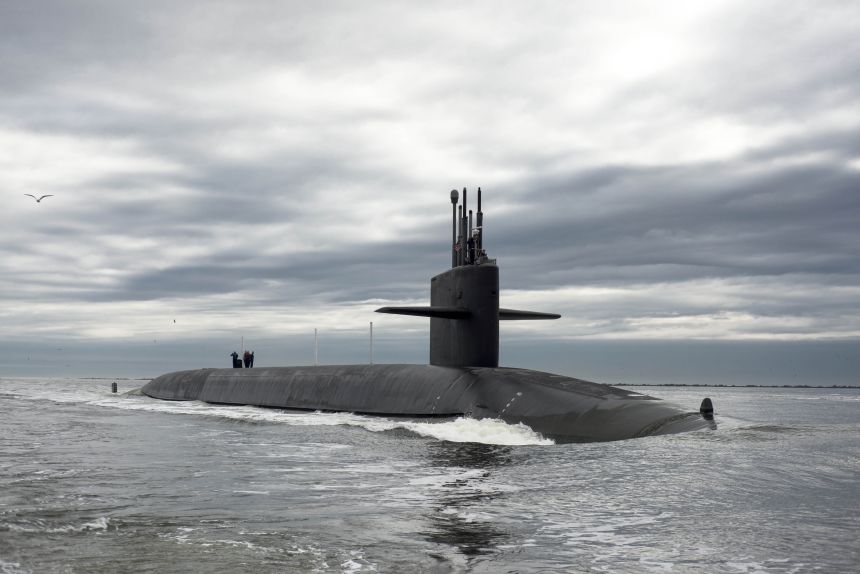
The Ohio-class ballistic missile submarine USS Tennessee returns to Naval Submarine Base Kings Bay, Georgia, on February 6, 2013.
US President Donald Trump said Friday he was ordering two US Navy nuclear submarines to “appropriate regions,” in response to remarks by Dmitry Medvedev, Russia’s former president and current deputy chairman of its Security Council.
In what he called an effort to be “prepared,” Trump said in a Truth Social post that he had “ordered two Nuclear Submarines to be positioned in the appropriate regions, just in case these foolish and inflammatory statements are more than just that.”
The president did not specify what type of submarines were being moved or where to, and the Pentagon usually reveals little about any of its subs’ movements.
The US Navy has three types of submarines, all of which are nuclear-powered, but only one of which carries nuclear weapons. Here’s a look at the US submarine fleet:
Ballistic-missile submarines
The US Navy has 14 Ohio-class ballistic-missile submarines (SSBNs), often referred to as “boomers.”
SSBNs “are designed specifically for stealth and the precise delivery of nuclear warheads,” a Navy fact sheet on them says.
Each can carry 20 Trident ballistic missiles with multiple nuclear warheads. Tridents have a range of up to 4,600 miles (7,400 kilometers), meaning they wouldn’t need to move closer to Russia to hit it – in fact, they could do so from the Atlantic, Pacific, Indian or Arctic oceans.
SSBNs are strong nuclear deterrents as they are expected to survive an adversary’s first strike. Their movements are among the Navy’s most closely guarded secrets.
At 560 feet (170 meters) long, the Ohio-class subs displace almost 19,000 tons submerged and have a crew of 159. They can reach a speed of 23 miles per hour.
Guided-missile submarines
In the 1990s, the Pentagon determined the Navy didn’t need as many Ohio-class SSBNs in the nuclear deterrent role, converting four of them into guided-missile submarines (SSGNs).
Retaining the same overall specs as the boomers, the SSGNs carry Tomahawk cruise missiles instead of the Trident ballistic missiles.
Each can carry 154 Tomahawks with a high-explosive warhead of up to 1,000 pounds, and a range of about 1,000 miles.
They can also transport troops, who can be clandestinely deployed from lockout chambers in former ballistic-missile tubes, according to the Navy.
Movements of the SSGNs are also highly classified, but in recent years the Navy made occasional note of their presence near military hotspots, to send a message of deterrence.
Fast-attack submarines
These form the bulk of the US Navy’s submarine fleet and are designed to hunt and destroy enemy subs and surface ships with torpedoes. They can also strike land-based targets with Tomahawk missiles, though they carry the Tomahawks in much smaller numbers than the SSGNs.
Fast-attack subs come in three forms: the Virginia, Los Angeles and Seawolf classes.
The Virginia class is the newest, with 23 commissioned as of July 1, according to a Navy fact sheet. They are 377 to 461 feet long, depending on their configuration, displace up to 10,200 tons, and have a crew of 145.
The Los Angeles class is the oldest of the Navy’s fast-attack subs, with 23 still in service. They are 360 feet long, displace 6,900 tons and carry a crew of 143.
Finally, the Seawolf class is the smallest in the US fleet.
Two of the subs, USS Seawolf and USS Connecticut – measuring 353 feet and displacing 9,100 tons – are more in line with standard attack boats, carrying torpedoes and cruise missiles.
The third in the Seawolf class, the USS Jimmy Carter, is one of the most specialized craft in the Navy, with a hull extended 100 feet longer than the other two subs.
“This hull section provides for additional payloads to accommodate advanced technology used to carry out classified research and development and for enhanced warfighting capabilities,” the Navy says.