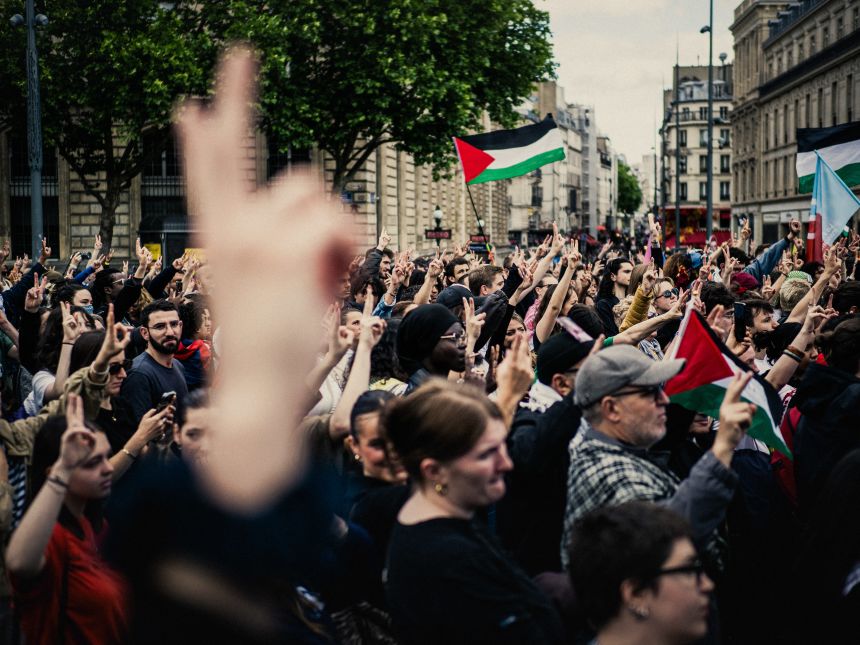
Crowds at a pro-Palestinian rally in Paris, France, on May 25.
First France, then the United Kingdom, and now Canada.
Three of the world’s most powerful Western nations have added their economic and geopolitical clout to calls for a Palestinian state, an idea already endorsed by more than 140 other countries.
The moves have many motives, from a sense of frustration with Israel, to domestic pressure, to outrage over the images of starving Palestinians. Whatever the reason, Palestinians have welcomed the announcements as a boost for their cause. The Israeli government has rejected the calls, describing them as tantamount to rewarding terrorism.
US President Donald Trump meanwhile seems increasingly frustrated with Israeli Prime Minister Benjamin Netanyahu, particularly over the starvation in Gaza that the Israeli leader denies, but has disturbed Trump.
Trump wants regional peace, as well as the accolades – namely a Nobel Peace Prize – for making it happen. He wants Saudi Arabia to normalize relations with Israel, expanding the Abraham Accords he cemented between Israel and several other Arab states during his first term. But Riyadh has been firm that this cannot happen without an irreversible path to a Palestinian state.
But the latest moves by US allies France, Britain and Canada – while in many ways largely symbolic – have left Washington increasingly isolated over its backing for Israel.
Palestinian statehood could help bring an end to a war that has killed more than 60,000 Palestinians in Gaza since Hamas’s brutal October 7 attack killed around 1,200 people in Israel almost two years ago, as well as bring home the hostages still being held in Gaza.
But one of the toughest challenges is imagining what it looks like, because a modern Palestinian state has never existed before.
When Israel was founded in the aftermath of World War II it quickly gained international recognition. That same period, for Palestinians, is remembered as al-Naqba, or “the catastrophe” – the moment when hundreds of thousands of people fled or were forced from their homes.
Since then, Israel has expanded, most significantly during the “Six Day War” of 1967, when Israel turned the tables on a coalition of Arab states and gained East Jerusalem, the West Bank and Gaza. Palestinian territory has meanwhile only shrunk and splintered.
The closest to what a future Palestinian state may look like was hashed out in a peace process in the 1990s which came to be known as the Oslo Accords.
