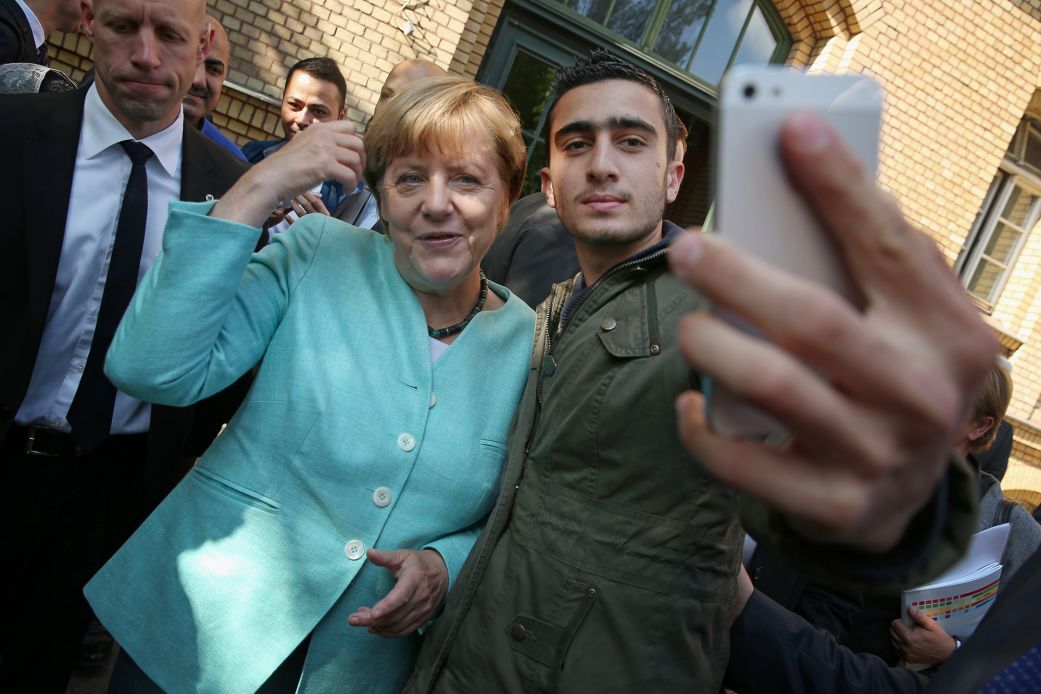
German Chancellor Angela Merkel poses for a selfie with Anas Modamani, a refugee from Syria, after she visited a shelter for migrants and refugees in Berlin, Germany, on September 10, 2015.
“When I think about the trip today, I wouldn’t do it again – it was so dangerous. What I remember is that many people died, they drowned … there were too many people on that boat.”
Anas Modamani, who as a teenager fled Syria’s brutal civil war for the safety of Europe in 2015, is one of many who ended up in Germany, where he still lives and now holds a passport.
Sitting in a Syrian cafe in Neukölln, a culturally diverse district of the German capital, Modamani is smiling and well-groomed.
He works in IT and in his own time is busy generating content for his thousands of TikTok followers. Yet he is no stranger to media fame. Just days after arriving in Berlin, a selfie he took with then-German Chancellor Angela Merkel went viral, as a symbol of the mood of the time.
This week marks a decade since Merkel’s historic decision to open her country’s borders to the large numbers of migrants who were then arriving in Europe in search of refuge from civil wars or dire economic hardship.
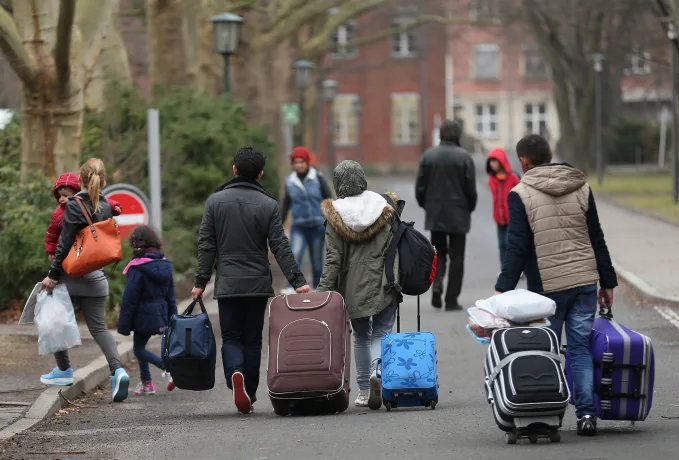
Images of people marching en masse along highways, carrying their possessions on their backs, are among the most enduring of modern Europe. And the repercussions of that moment are still felt today in both German and European politics.
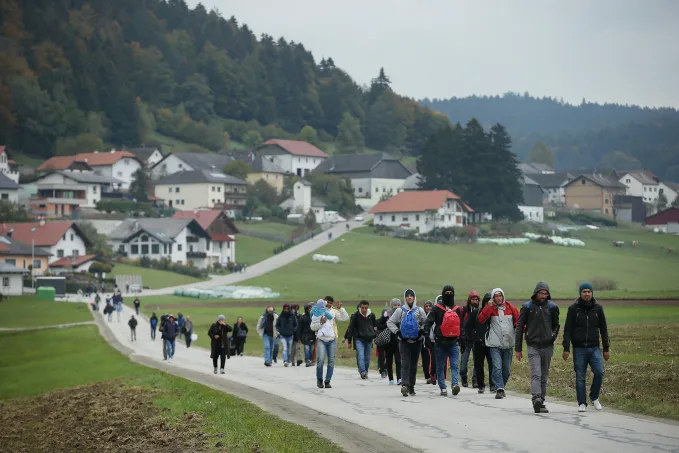
Hundreds of thousands of people aimed to reach Germany, a bastion of economic stability and prosperity. Merkel welcomed them, declaring on August 31, 2015, “Wir schaffen das,” or “We can do this.” That became a phrase symbolic of a wider approach known as Willkommenskultur, or welcome culture.
But it’s a legacy that Germany is still wrestling with, with the far-right Alternative for Germany (AfD) party riding a wave of anti-immigration sentiment to become the country’s largest opposition group.
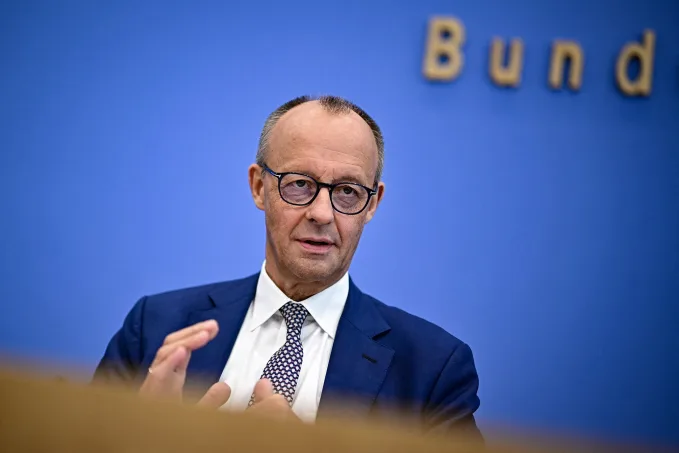
Chancellor Friedrich Merz, aware of the threat from the right and long opposed to Merkel’s policies on migration – despite leading the same CDU party – announced sweeping revisions to migration policy after taking office earlier this year. They included the deployment of thousands of more border guards and the turning away of asylum seekers at the border, a step since ruled unlawful by a Berlin court.
“We clearly did not cope with it. That is exactly why we’re trying to fix it,” Merz said of the situation in July.
As the regime of Bashar al-Assad was collapsing in Syria at the end of 2024, thousands took to the streets in celebration. It provided Alice Weidel, co-leader of the AfD, with another opportunity to call for Syrians in Germany to go back.
Weidel posted on X that, “anyone in Germany who celebrates the ’free Syria’ clearly no longer has any reason to flee. They should return to Syria immediately.”
‘Best moment of my life’
The world looked very different when Modamani arrived in Germany in early September 2015, aged 17. He recounts an arduous 30-day journey that took him through Lebanon, Turkey, Greece, the Balkans, Hungary, Austria and, eventually, to Germany.
He said he moved constantly, on foot, with other migrants, through fields, along roads and over mountains, as well as making a perilous boat crossing.
“I was alone, I had no family, no friends. I left Syria alone because of the war and I didn’t want to join the military… I was such a small child who didn’t know much about life,” he told CNN.
After Merkel’s famous August 31 announcement, thousands of people arrived in southern Germany on September 5 and the following days – Modamani among them.
He describes reaching the city of Munich as “the best moment of my life.” Locals had gathered to clap and to distribute food and water to migrants as they arrived.
Modamani’s journey, though, was about to take another unexpected twist. A few days later, he took that selfie with Merkel while she visited a refugee center in the Berlin suburb of Spandau. Images of him taking the photo made front pages around the world – and turned Modamani into a figurehead for the Syrian refugees now pouring into Germany.
“I thought she was an actress or movie star,” Modamani told CNN, recalling that moment. While they couldn’t understand each other, as Modamani could only speak Arabic then, “she noticed that I wanted to take a picture with her and she was OK with that,” he said.
“This woman visited us in a refugee home because she knew that she had saved so many lives and she wanted to see how people are doing that she let into the country.”
In 2015 and 2016 alone, a staggering 1,164,000 people applied for first-time asylum in total.
From January 2015 to December 2024 Germany registered 2.6 million first-time asylum requests from a variety of nations, according to its Federal Office for Migration and Refugees (BAMF).
The vast majority of those applications came from nationals of Syria, Afghanistan and Iraq, countries beset by long-simmering conflict. Syrians accounted for more than a third of the requests in those two years.
The numbers dropped off after 2016 but dramatically rose again in 2022, following Russia’s full-scale invasion of Ukraine.
Germany has remained the number one nation within the European Union for asylum applications for the last decade.
Between 2015 and 2024, data provided by Eurostat, the EU’s statistical office, shows that just under 8 million (7,984,765) applications were made across the EU. Over a third of the applications were filed in Germany.
Those huge figures, at least in part a result of Willkommenskultur, have contributed to a significant rise in anti-immigration sentiment in Germany, but also across Europe.
German experts told CNN that no one, including Merkel, was prepared for the sheer number of people who entered the country.
“Germany came from really low numbers, roughly 40-50,000 per year for more than a decade,” Daniel Thym, a law professor and director of the Research Center Immigration and Asylum Law at Germany’s University of Konstanz , told CNN. “So, in Germany, nobody really expected this to be this big, both in 2015 and in the years thereafter.”
Asked if he felt that Merkel lost control of the situation, Thym responded: “I think she did.”
Hannes Schammann, a political science professor with a focus on migration policy at Hildesheim University, echoed those views, adding that Merkel’s decision was based on pragmatism, given that no other European nation was ready to help.
“Merkel had to kind of open the doors because she wanted to stabilize the common European asylum system… she did not have an alternative,” he told CNN. Schammann views the move as having been motivated more by politics than altruism, and as rooted in Merkel’s belief that Germany was better equipped than other nations to handle the crisis.
Merkel rarely makes public appearances these days, but in a documentary released this month by German public broadcaster ARD, she said: “I simply realized that it was a big task. And I didn’t say I could do it, I said we could do it, because I was also hoping for the people in the country (to help).”