Great White Shark Sighting Stuns Beachgoers in Santa Monica Bay
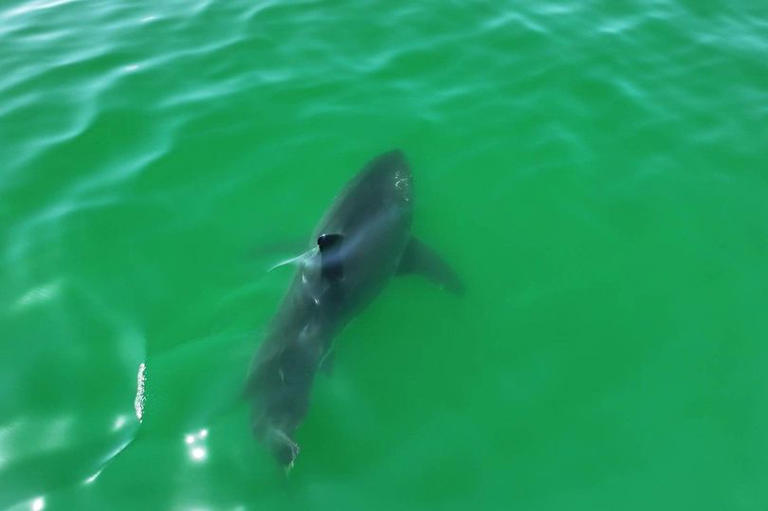
Beachgoers in Santa Monica Bay were left both amazed and uneasy this week after a great white shark was spotted swimming just offshore, its dorsal fin cutting cleanly through the late-summer swells. The encounter, caught on camera by several stunned onlookers, quickly spread across social media, sparking equal parts fascination and anxiety in a community accustomed to crowded beaches but not to the presence of one of the ocean’s most formidable predators.
The sighting occurred on a bright, warm afternoon, when dozens of swimmers, surfers, and paddleboarders were enjoying the calm waters near the shoreline. Witnesses say the shark appeared without warning, its fin rising above the surface about 100 yards from the beach. Some initially mistook it for a dolphin, a common sight in these waters, but the telltale triangular shape and the slow, deliberate motion through the waves soon made it clear this was something far larger and more intimidating.
Several lifeguards on duty immediately began alerting people in the water, signaling them to head toward shore. Within minutes, whistles pierced the air and swimmers moved quickly out of the surf zone. While there was no sign of aggressive behavior, lifeguards decided to temporarily clear the water as a precaution. According to witnesses, the shark lingered for several minutes, occasionally circling before slowly moving farther out toward deeper water.
For many locals, the moment was both thrilling and unnerving. Longtime Santa Monica resident Kevin Alvarez, who was jogging along the sand when he noticed the commotion, described the scene as “surreal,” saying he had lived in the area for over 20 years and never seen a great white so close to shore. Surfers who had been in the water minutes earlier watched from the sand, their boards tucked under their arms, as the shark’s fin dipped in and out of view. Several bystanders pulled out their phones, recording video that has since racked up thousands of views online.
Experts say sightings like this, while rare, are becoming more common along California’s coast as conservation efforts and environmental conditions draw sharks closer to shore. Marine biologists note that juvenile great white sharks, in particular, are often found in shallow coastal areas where the water is warmer and prey such as fish and rays are abundant. Santa Monica Bay, with its sandy bottom and temperate waters, can offer an ideal habitat for these younger sharks, which can still measure six to ten feet in length.
Dr. Ellen McCarthy, a marine ecologist specializing in shark behavior, explained that great white sharks play a critical role in maintaining the health of ocean ecosystems. “They are apex predators, which means they help regulate the balance of marine species,” she said. “Encounters like this are usually not dangerous as long as people remain calm and follow lifeguard instructions. The shark is not here for us—it’s here for food sources in its natural environment.”
Still, the presence of a great white so close to swimmers is enough to put many on edge. While shark attacks in California are exceedingly rare, the great white is the species most often involved in the small number of incidents reported. State records show that in the past decade, confirmed great white encounters in Southern California waters have increased, though almost all involve brief sightings without injury. Factors such as warmer ocean temperatures, shifting currents, and growing marine mammal populations have been linked to the rise in appearances.
Following the sighting, lifeguards kept the area under close watch for the rest of the day. By the following morning, there had been no further reports of the shark in the immediate vicinity, and beach activities resumed as normal. Officials emphasized that the sighting should be seen as a reminder of the natural wildlife that shares the ocean rather than a reason for panic. “The ocean is their home,” one lifeguard captain remarked. “We just need to be aware and respectful when we’re in it.”
For some beachgoers, the experience was more awe-inspiring than frightening. Children pointed excitedly at the water as parents explained the rarity of such an encounter. A few tourists admitted they felt lucky to witness something they had only ever seen in documentaries. “It’s a story I’ll be telling for years,” said one visitor from Chicago, who had been standing on the pier when the shark appeared.
Social media reactions to the videos have ranged from playful jokes about “Jaws” to serious discussions about ocean safety. Marine life advocates have urged viewers to resist fear-based reactions and instead focus on learning more about the species and its role in the environment. Local conservation groups are using the moment to promote shark awareness programs, offering educational talks and distributing information on how to coexist safely with these apex predators.
Despite the initial alarm, there is a sense among many that the event brought the community a little closer to the ocean’s wild side. Encounters like this serve as a vivid reminder that even in bustling coastal cities like Santa Monica, the sea remains a domain of untamed beauty and power. The sleek dorsal fin cutting through the waves was a brief, dramatic symbol of that truth—a reminder that the Pacific is home to creatures whose lineage stretches back millions of years, long before human feet touched these sands.
As the late afternoon sun dipped toward the horizon and the waves rolled in once again without interruption, the beach returned to its usual rhythm. Children played in the shallows, surfers paddled out to catch the next set, and gulls wheeled overhead. Somewhere beyond the breakers, perhaps miles away by now, the great white shark continued its silent patrol, unseen but not forgotten by those who witnessed its visit. For a few extraordinary minutes, the line between the familiar and the wild had blurred, leaving behind a story that will ripple through Santa Monica for a long time to come.